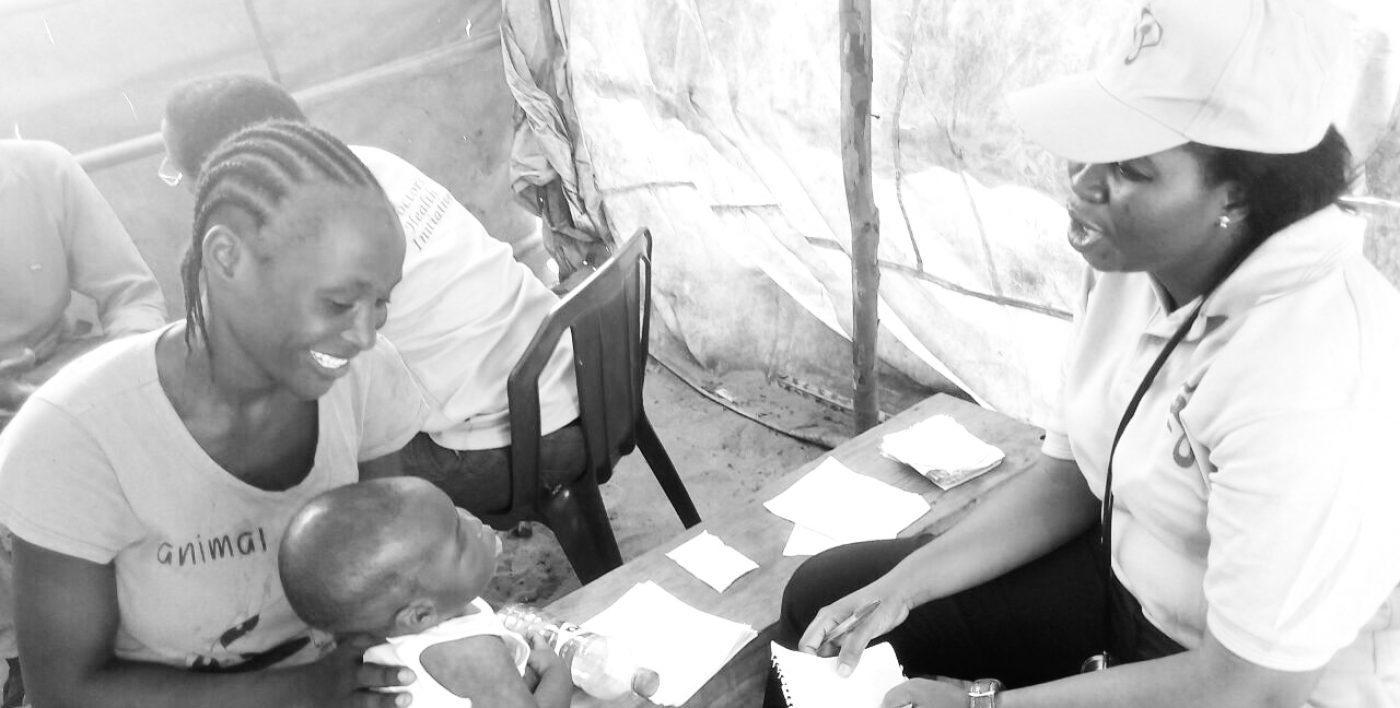
Sharing love and bringing hope to IDPs

*Throwback

Doctors Health Initiative (DHI), a not for profit, non-governmental organization made up of medical doctors and other professionals, held a 3 day medical outreach at the Internally Displaced People’s (IDP) camp in Benin Edo State between the 12th to the 14th of February, 2015. This was done in partnership with Novo Health Africa, a health maintenance organization accredited by the National Health Insurance Scheme with the objective to provide health care delivery solutions across Nigeria and internationally through collaborative partnerships.

The team of about 15 people was led by Dr. Nkechi Asogwa, a medical practitioner and Director of the NGO. The members of the organization and some volunteers including medical doctors, nurses, pharmacists and nutritionists, decided to show some love and reach out to about 2,000 inhabitants in the Benin IDP camp comprising mostly of 80 % women and children and 20 % men. The aim was to give humanitarian aid, medical treatment and bring hope to the victims of the Boko Haram insurgency residing in the camp. Most of the ailments were treatable and many of them had worm infestations and most of the children were malnourished. The children in this camp along with the adults, have meager meals and eat only twice a day depending on the availability of food. There are times they eat only once and when there is no food supply, they have no meals at all. The children in this camp are aged 0-12. They do not have a balanced diet most times.

Some well-meaning individuals and companies like the wife of the Edo State governor donate food items for the camp sporadically but this is not enough with so many little mouths to feed.

The team also inspected their kitchen and environs to check the hygiene standards. It was discovered that at the camp, they do not have enough portable water even with three boreholes though only one was functional. When there are power cuts, the bore hole does not work at all. They are dependent on electricity from a nearby village.

Some of the IDPs also had open wounds; some will need psychotherapy as they have had very horrible and traumatic experiences. The people in charge of the camp said that at times the children and women just start crying and some of them just get up and start running and they in the camp have to go after and catch them. Many saw their parents, husbands and sons killed right before them in very horrible ways. Some Neuro-physciathrists had visited the camp and volunteered their services but that was not enough with so many people. Some of the very critical patients were taken away by these volunteer doctors for treatment and then returned to the camp. Some of the very critical patients seen at the camp at the time of DHI outreach were referred to the University of Benin Teaching Hospital hoping they will be attended to. Pastor Solomon Folorunsho who is in charge of the camp said it was very difficult getting funding but that he will source for it so that the very critical patients can be taken care of. Dr. Asogwa hopes and is working towards getting funds from individuals and organizations to assist these people. There was one of the patients seen, a 12-year-old boy, that seemed to have fractured his hip and was in extreme pain. He fell while running away from the terrorists after they have killed his parents. He would be needing urgent attention and immediate surgery without which he may never be able to walk properly again. He could only be treated for pain which was not solving the major problem. There was another case of a young girl of about 10 years who saw her father been killed brutally by the Boko Haram terrorists. She and her mother witnessed their father and husband been flayed and cut. Some women seen could not even narrate their ordeal. When asked about their experiences in order to ascertain their treatment, they just broke down and started weeping.

Another visit to the camp in Benin is planned for June 2016 and the DHI director has also received calls from the IDP camps in Yola where they worked last year calling for help. Last year, DHI under the umbrella of Foundation for African Cultural Heritage (FACH), a coalition of NGOs visited and gave humanitarian aid over a 4-day period to victims of the Boko Haram insurgency at 2 major IDP camps in Yola. The IDPs were attended to medically, given clothes, footwear and most especially a lot of food items.

DHI is grateful to all her volunteers who selflessly gave themselves and their time. They would never forget this humanitarian help to their fellow human beings.

The DHI is only trying to bring help and support to the venerable in our society and is calling on other individuals and organizations to do same and not just pay lip service to the issues on ground concerning fellow Nigerian citizens.

Written by Ms. Bimpe Adebambo

Volunteer, DHI

Some of the pictures of the recent Health outreach are attached.

This slideshow requires JavaScript.

My Visit to the IDP Camp: How and Why I Lost My Right To Complain About Anything

The occasion was Easter Monday. I left Lagos about 8am in the company of a friend who shared the same urge to extend the Easter Celebration to any person or group of persons in need. We drove down to Benin to spend some time and exchange a few gifts with the IDPs at the *IDP camp. We returned to Lagos the same day tired but refreshed. I am happy to share my story with you.

So many things motivated my decision to visit these poor victims of Boko Haram insurgency. I was particularly inspired by the generous work some of my friends were doing under the auspices of The Foundation for African Cultural Heritage (FACH). These friends some, doctors and  non-doctors  devoted generous amounts of their time and skills to mobilising resources from anyone and anywhere they could reach, transporting such relief materials to the camps across the country and giving free medical care to the sick amongst the IDPs. I am not a Doctor and knew that I did not have enough time to volunteer. Being almost envious of how full a life these professionals were living, I decided to find a way to do something.

More out of good fortune than hard work, my good intention got a boost almost as soon as it was conceived. A chain of conversations led to someone in Germany mobilizing a truck load of fairly used household and educational materials. Another person volunteered to clear them free of charge. We sorted and earmarked them for different IDPs, motherless babies’ homes and other hospices. We drove down to Benin with an SUV filled with some of the materials and we were happy with ourselves.

At the camp, we were received and cleared to enter the camp with the help of one of the Doctors Health Initiative (DHI) member Doctors who lives and works in Benin. I’d say that getting into the camp was the last moment of excitement on that trip for so many reasons, some of which are below.

·         When we offloaded our materials, they simply disappeared because it was like we dropped a cup of water in the sea.

·         The camp at the time had 2200 (Two Thousand, Two Hundred) inmates and a meal (not a day’s feeding need) was 10-12 bags of rice at the time.

·         We met a number of German nationals helping out because they volunteered, got sponsored and flew down to this country to assist the IDPs with their time and skills.

·         The camp was simply a bush with a few tents and cleared patches. I could not imagine at the time how they’d cope with the rainy season and flood.

·         Several months of deprivation, malnutrition, pain, fear, forced migration and loss to mention a few, meant that as many as were sick did not have the means to buy primary medical care

·         Even when the Doctors were there to offer free consultation and drugs, the sick needed an interpreter to describe their symptoms. In one instance a young girl of about 6 years who must have been receiving excellent education and with a bright future was the interpreter. This little girls didn’t know where her parents were but she was alive and helping others get medical treatment.

·         The boys probably bled a rubber tree, left the rubber to coagulate after which they forced it into a circular shape and a soccer ball was in place. They played football and they were happy.

·         A lot of the kids in the camp had lost their parents and were mapped to foster parents some of who had lost their own children just to create a family setting for the children to develop.

·         Overall, I was stunned by the fact that in the “mess” they lived, they were still capable of happiness which came through in the form of genuine gestures of gratitude and generous doses of infectious smiles.

For most of the drive back to Lagos, I was lost in the contemplation of what I just witnessed.

Seeing how these brethren of ours coped with the circumstances our collective mistakes forced on them, I could not help but recall what Viktor Frankl wrote in Man’s Search for meaning. Everything can be taken from a man but one thing: the last of the human freedoms—to choose one’s attitude in any given set of circumstances, to choose one’s own way.” 

Clearly, the IDPs chose to remain happy and that begs the question; what have you chosen today? I urge you to choose to help because as Victor Frankl rightly asserted in the same book, “Being human always points, and is directed, to something, or someone, other than oneself—be it meaning to fulfill or another human being to encounter. The more one forgets himself—by giving himself to a cause to serve or another person to love—the more human he is and the more he actualizes himself. … What is called self-actualization is not an attainable aim at all, for the simple reason that the more one would strive for it, the more he would miss it. In other words, self-actualization is possible only as a side-effect of self-transcendence.” I understand this to mean that it is selflessness that gives meaning to our humanity.

Let us all therefore reach beyond ourselves, transcend ourselves today and become the leaven that will increase our individual and collective humanity. Every tear the IDPs shed at night while we slept is our tear, every pain they bear is our pain. Let us therefore help generously so we can share in every smile they share.

It is for these reasons that I felt that after I left that camp, I lost my rights to complain about anything.

This slideshow requires JavaScript.

*IDP: Internally Displaced Person

Written by Mr. Chidi Ileka

One Day

It was a day full of hills and valleys, storms and clear skies, feast and famine.
The car refused to start and the much-anticipated camp visit seemed to die before it was birthed. To the rescue came Über and soon our donations (good quality used children’s books), our packed lunches, my two children and I were off on our first visit to an IDP camp.
Uche who drove us, was good to converse with and the drive to Eleko Beach road was soon over. That was where the dream ended and the nightmare began. After frantic calls we turned right into the untarred road that was more obstacle course than road. The “just keep going down” we were told by way of directions seemed to be never-ending. Near despair, we saw a makeshift shelter and with relief, we realized we were finally there.
Leaf green T-shirts and baseball caps were everywhere, some taking biostatistics, others consulting and others dispensing. After meeting, I got a chance to sit and talk with Moses. Listening to the history of this predominantly Chibok community, how and why it is not an official camp and the aftermath of the recent release of 21 of the kidnapped girls, one felt like one had stepped into a twilight zone. However all around me, I could see the real fallout of the saga; women without their usual form of livelihood and children idling about out of school.


We were interrupted as my attention was called to a lady with a gynaecological complaint. Finally!! I was going to be useful. I had strayed into the consulting area once and quickly run out. Ah!! When last did I treat a child? *ALAKOBA!! The lady seen, I was soon able to get the women together for a women’s health talk.
Choosing a lingua franca for the talk was the first challenge as having an interpreter was not going to be enough. Apparently, some of the women spoke Hausa and none of the local Chibok dialect. My interpreter did not speak Hausa well so it was decided…Pidgin. It was actually fun describing the need for self breast examinations, symptoms of vaginal infections and cervical cancer in Pidgin English. Ending with a passionate plea for pregnant women yet to register for antenatal care due to financial difficulties to step forward, the health talk ended.
Brooding on the death of one of these women while delivering at home because of the N9,000 registration fee at the maternity centre, my reverie was soon broken by a long line of women waiting to see me for the same gynaecologic problem…thrush. Antifungal medications were not one of the free drugs we had available so we made a list of those who we would send the drug to once we got back. Another pressing need identified was family planning that would be safe, cheap and acceptable.
Getting ready to leave, it was obvious that the community had many needs we would have to collaborate with others to meet. From cervical cancer screening to education, much was required to serve the community holistically. We left knowing it had been a day well spent, yet demanding more of such.  God was truly guiding all our steps and so with joy we looked forward to more days in His service.
*alakoba: a Yoruba slang
Written by Dr Obi
Contact: obideh@gmail.com